

The Middle Eastern or North African (MENA) checkbox is a new minimum reporting ethnic category on the decennial census and other federal surveys. Learn more about the category by downloading our FAQs.
Read More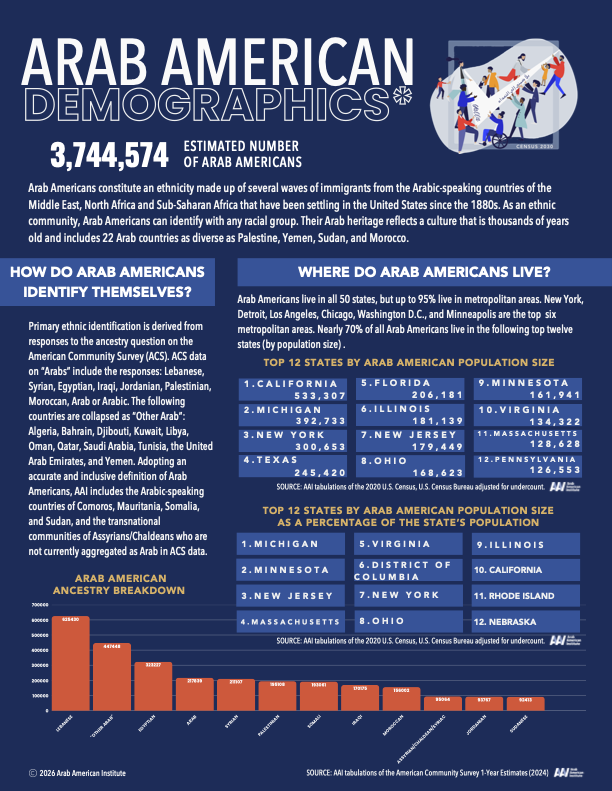
Arab Americans, the largest population within the MENA category, constitute an ethnicity made up of several waves of immigrants from the Arabic-speaking countries of the Middle East, North Africa and Sub-Saharan Africa that have been settling in the United States since the 1880s
Read More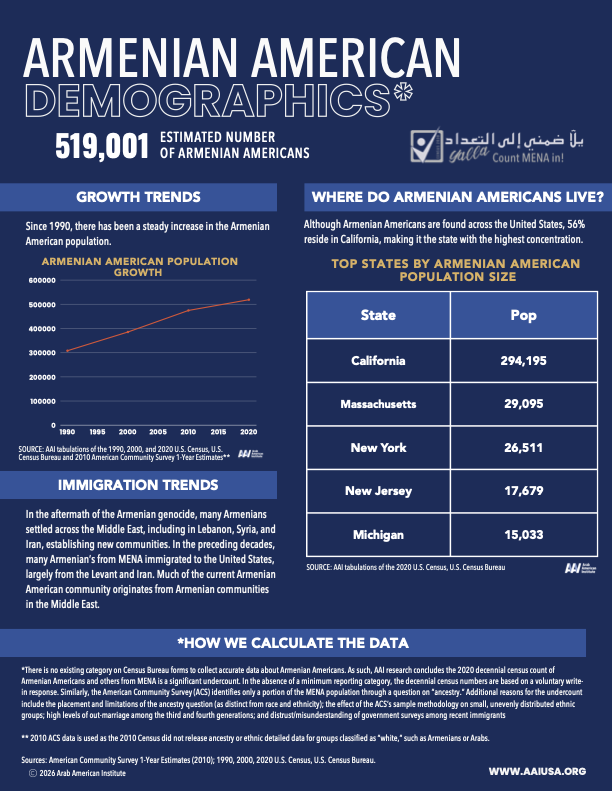
Armenian Americans are the largest transnational community within the MENA category.
Read More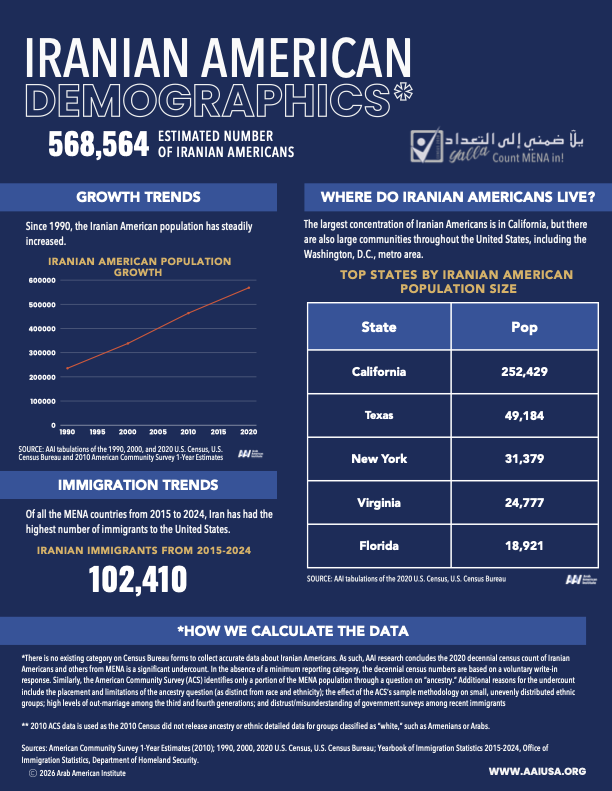
Iranian Americans are one of the largest populations within the MENA category.
Read More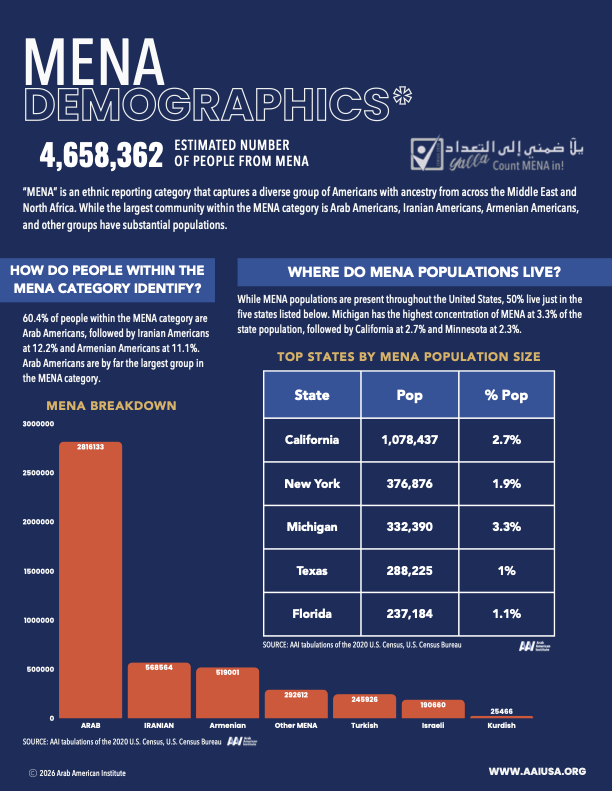
“MENA” is an ethnic reporting category that captures a diverse group of Americans with ancestry from across the Middle East and North Africa. While the largest community within the MENA category is Arab Americans, Iranian Americans, Armenian Americans, and other groups have substantial populations.
Read More
The principle of data equity and the practice of data disaggregation are important foundations in the Arab American community’s push for a MENA category. Download our fact sheet below to learn why these tools are so important, and how they affect Arab Americans.
Read More
The Office of Management and Budget’s 2024 Revisions to the Standards for the Classification of Federal Data on Race and Ethnicity
Read More
AAI’s statement on the Office of Management and Budget (OMB) announced revisions to Statistical Policy Directive No. 15: Standards for Maintaining, Collecting, and Presenting Federal Data on Race and Ethnicity Data. AAI Welcomes New MENA Category & Revision of Race and Ethnicity Standards: Hailed Historic Category Fails to Capture Full Diversity of Arab American Community.
Read More
بقلم الدكتورة كارين أورفيس، رئيسة الإحصائيي بالولايات المتحدة
يف وقت سابق اليوم، ن رش مكتب الإدارة والميانية مجموعة من التنقيحات للتوجيه رقم 15 المتعلق بالسياسة الإحصائية (التوجيه رقم 15): معايي الحفاظ على البيانات الفيدرالية المتعلقة بالانتماء العر يف وجمعهاوعرضها،ويهالأولىمنذعام1997.وقدبدأتهذهالعملية يفحزيران/يونيو2022،معأول اجتماع لمجموعة العمل الف ين المشيكة بي الوكالات المكونة من الموظفي المهنيي يف الحكومة الفيدرالية الذين يمثلون ال ريامج ال ين تجمع أو تستخدم بيانات الانتماء العر يف.ومنذ ذلك الاجتماع الأول، قمنا بمراجعة 20 ألف تعليق وعقدنا ما يقرب من 100 جلسة استماع لوضع اللمسات الأخية على المعايي المهمة ال ين نعلن عنها اليوم.
Read More
By Dr. Karin Orvis, Chief Statistician of the United States: Earlier today, OMB published a set of revisions to Statistical Policy Directive No. 15 (Directive No. 15): Standards for Maintaining, Collecting, and Presenting Federal Data on Race and Ethnicity, the first since 1997. This process started in June 2022, with the first convening of the Interagency Technical Working Group of Federal Government career staff who represent programs that collect or use race and ethnicity data. Since that first convening, we’ve reviewed 20,000 comments and held almost 100 listening sessions to finalize the important standards we are announcing today.
Read More
AAI’s comment in response to the Federal Register Notice supports the revision of the race and ethnicity standards, including updating Directive 15 to include the addition of “Middle Eastern or North African (MENA)” as a new minimum reporting ethnic category, supporting a combined question format on race and ethnicity, and the mandatory collection of detailed race and ethnicity by default.
Read More
The Leadership Conference on Civil and Human Rights’ coalition comment in support of revising OMB’s race and ethnicity standards.
Read More
This draft community comment in support of the MENA category was submitted by hundreds of you during the Federal Register Notice open comment period regarding the Office of Management and Budget’s revision of the race and ethnicity standards.
Read More
Current federal standards are inadequate. Right now, we have a unique opportunity to impact how the federal government sees people and populations. OMB’s proposed revisions to the federal race and ethnicity standards include the addition of the MENA category to the classification system. AAI’s Claudia Youakim shares why this critically important update will bring visibility to Arab Americans, their contributions, and their particular needs.
Read More
A Fact Sheet and FAQ from the Leadership Conference Education Fund on why adopting a combined question would be a critical step forward in allowing more people to see themselves accurately reflected in federal data.
Read More
From the archive, a fact sheet from the first national Arab American get-out-the-count campaign. It was organized in the lead up to the 1990 Census: “Arab Americans are a growing ethnic constituency and contribute to every part of American society. The 1990 Census is our chance to get an accurate count of how many persons of Arabic-Speaking descent live in the United States and an understanding of their diversity.”
Read More
During a recent roundtable conversation, Meeta Anand, senior director of the census and data equity program at The Leadership Conference on Civil and Human Rights, joined Maya Berry, executive director of the Arab American Institute, and Professor Neda Maghbouleh to discuss Maghbouleh’s book “The Limits of Whiteness” and why adding a MENA category matters.
Read More
The U.S. Office of Management and Budget (OMB) undertakes periodic reviews of its Federal statistical standards to ensure that they are keeping pace with changes in the population and evolving needs and uses for data. In 2022, OMB convened the Federal Interagency Technical Working Group on Race and Ethnicity Standards (Working Group).
Read More
The Leadership Conference Education Fund’s Fact Sheet on Collecting and Publishing Federal Data on Race and Ethnicity: Understanding OMB Directive 15.
Read More